

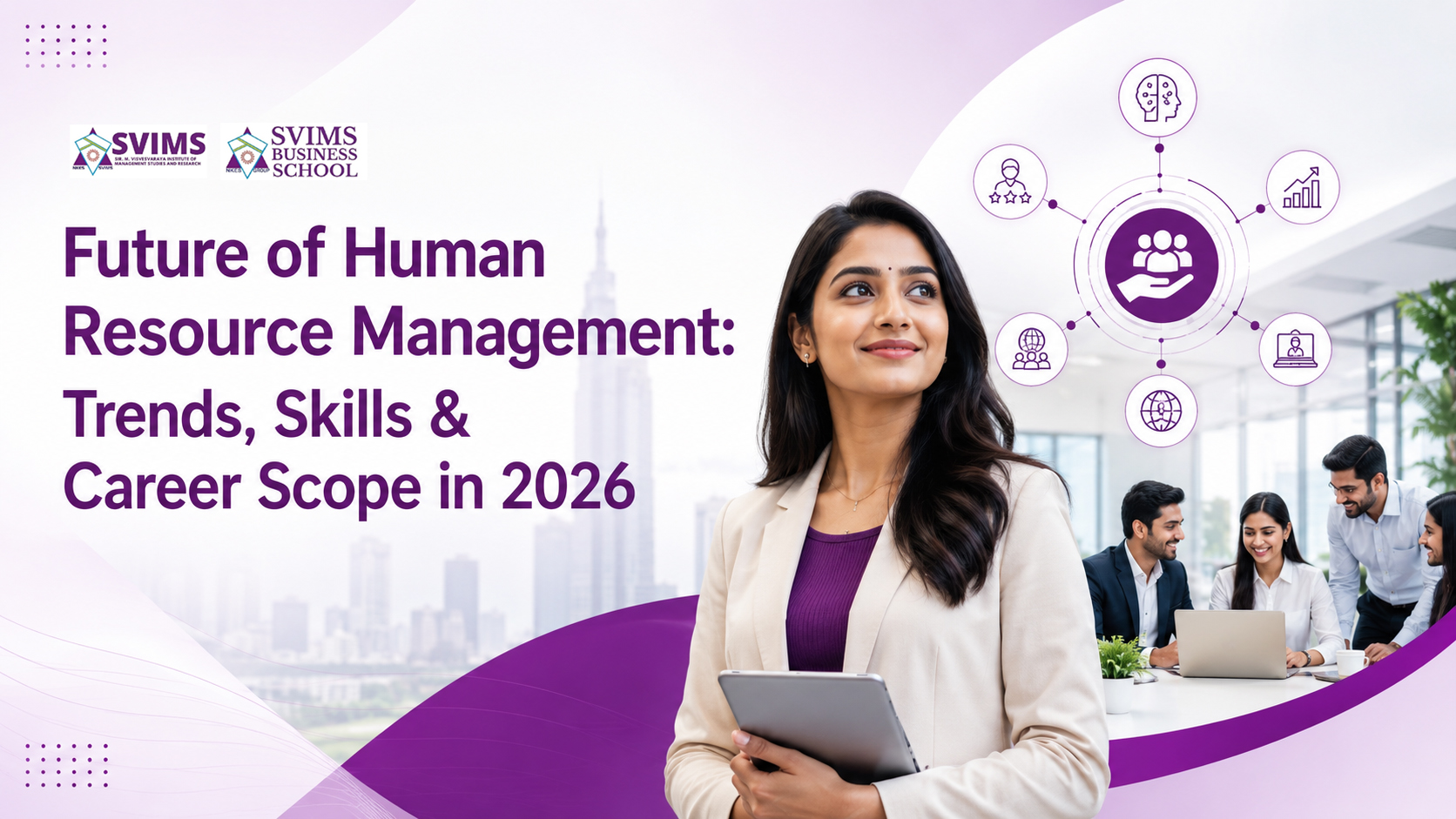
Future of Human Resource Management in 2026: Trends, AI Impact & Career Opportunities
Introduction:
Human Resource Management (HRM) has evolved far beyond hiring and payroll administration. In 2026, HR professionals are expected to shape organizational strategy, build high-performing teams, leverage workforce analytics, and create employee experiences that drive business growth. As Artificial Intelligence (AI), automation, and digital transformation continue to redefine workplaces, HR has become one of the most dynamic and future-focused management specializations.
For students planning a career in people management, understanding the future of Human Resource Management is essential before choosing a postgraduate programme. Today’s employers seek HR professionals who combine business acumen with leadership, analytical thinking, technology awareness, and strong interpersonal skills.
The AICTE-approved PGDM at SVIMS Mumbai prepares future HR leaders through an industry-oriented curriculum, dual-specialization opportunities, exposure to business analytics, industry certifications, corporate interactions, and long-duration internships, helping students build capabilities that align with the future of work.
What Is the Future of Human Resource Management?
The future of Human Resource Management is centered on strategic workforce planning, AI-enabled decision-making, employee experience, HR analytics, leadership development, and organizational transformation.
Modern HR professionals are no longer limited to administrative responsibilities. Instead, they work closely with leadership teams to attract talent, improve employee engagement, manage organizational change, and build workplace cultures that support innovation and business performance.
As organizations adopt digital technologies, HR professionals capable of interpreting workforce data and making strategic decisions will remain in high demand across industries.
Why Human Resource Management Is Becoming More Important
Every successful organization depends on its people. While technology can automate repetitive processes, businesses still rely on human leadership, collaboration, creativity, and emotional intelligence.
Today’s HR departments contribute to:
- Talent acquisition and employer branding
- Leadership development
- Performance management
- Employee engagement
- Workforce planning
- Organizational culture
- Learning and development
- Diversity, Equity & Inclusion (DEI)
- Change management
This expanding role has transformed HR into one of the most influential business functions.
Future Trends of Human Resource Management
The workplace is changing rapidly, and HR professionals are expected to lead this transformation.
1. AI-Powered Recruitment
Artificial Intelligence is improving recruitment by helping organizations:
- Screen resumes efficiently
- Match candidates with job roles
- Reduce hiring time
- Improve recruitment accuracy
However, final hiring decisions continue to require human judgment, making HR professionals essential to the recruitment process.
2. HR Analytics and Data-Driven Decisions
Organizations increasingly rely on workforce analytics to understand employee performance, retention, productivity, and engagement.
Future HR professionals will need skills in:
- Business Analytics
- HR Metrics
- Workforce Analytics
- Data Interpretation
- Performance Dashboards
These analytical capabilities are becoming as important as traditional people management skills.
3. Employee Experience as a Business Strategy
Organizations now recognize that employee satisfaction directly influences customer experience and business success.
Future HR leaders will focus on:
- Employee well-being
- Career development
- Workplace culture
- Learning opportunities
- Leadership coaching
Creating positive employee experiences has become a strategic business objective rather than an HR initiative alone.
4. Hybrid and Remote Workforce Management
Flexible work models continue to reshape organizations.
HR professionals are responsible for developing policies related to:
- Hybrid work
- Remote collaboration
- Digital communication
- Employee engagement
- Performance evaluation
Managing geographically distributed teams has become an important leadership capability.
5. Continuous Learning and Upskilling
Rapid technological change requires organizations to continuously develop employee capabilities.
HR departments increasingly lead:
- Learning initiatives
- Leadership programmes
- Professional certifications
- Workforce reskilling
- Career development planning
This makes Learning & Development one of the fastest-growing HR functions.
AI Impact on Human Resource Management
Artificial Intelligence is transforming HR operations but is not replacing HR professionals.
Instead, AI is helping automate repetitive tasks while allowing HR teams to focus on strategic responsibilities.
HR Activities Enhanced by AI
| AI Application | HR Benefit |
| Resume Screening | Faster candidate shortlisting |
| Recruitment Automation | Improved hiring efficiency |
| Employee Analytics | Better workforce insights |
| Performance Tracking | Data-driven evaluations |
| Learning Platforms | Personalized employee development |
| HR Chatbots | Faster employee support |
| Predictive Analytics | Improved workforce planning |
AI serves as a decision-support tool rather than a replacement for human expertise.
Will AI Replace HR Jobs?
No.
AI can automate administrative activities, but HR remains fundamentally people-centric.
Organizations still require professionals who can:
- Build relationships
- Resolve workplace conflicts
- Develop leadership talent
- Foster organizational culture
- Lead change initiatives
- Make ethical business decisions
These responsibilities require emotional intelligence, communication, empathy, and strategic thinking, qualities that technology cannot replace.
As AI adoption increases, HR roles are expected to evolve rather than disappear.
Challenges and Opportunities Affecting the Future of Human Resource Management
Like every business function, HR faces both opportunities and challenges in the coming years.
| Challenges | Opportunities |
| Rapid technological change | AI-enabled HR transformation |
| Changing employee expectations | Strategic workforce planning |
| Talent shortages | Employer branding initiatives |
| Hybrid workforce management | HR Analytics adoption |
| Employee retention | Leadership development programmes |
| Continuous skill development | Learning & Development expansion |
Organizations that successfully address these challenges are likely to build stronger, more resilient workforces.
Future Scope of Human Resource Management in India
India’s growing economy, expanding startup ecosystem, multinational investments, and digital transformation initiatives continue to increase demand for skilled HR professionals.
Career opportunities are available across:
- Information Technology
- Banking and Financial Services
- Manufacturing
- Healthcare
- Consulting
- Retail
- E-commerce
- Education
- Logistics
- Hospitality
As businesses expand, the need for professionals who can attract, develop, and retain talent is expected to grow consistently.
Career Opportunities After Human Resource Management
A specialization in Human Resource Management opens opportunities across multiple business functions.
| Job Role | Primary Responsibilities |
| HR Manager | Workforce planning and employee management |
| Talent Acquisition Specialist | Recruitment and hiring |
| HR Business Partner | Strategic HR planning |
| Learning & Development Manager | Employee training and development |
| Compensation & Benefits Analyst | Rewards and payroll strategy |
| Employee Relations Manager | Workplace engagement and conflict resolution |
| HR Consultant | Organizational and HR advisory services |
| Organizational Development Specialist | Change management and leadership development |
These roles provide opportunities for progression into senior leadership positions such as Head of HR, Chief Human Resources Officer (CHRO), and Talent Strategy Director.
Salary After Human Resource Management
Compensation depends on industry, organization, location, skills, certifications, and experience.
| Experience Level | Approximate Salary Range |
| Entry-Level (0–2 Years) | ₹4 LPA – ₹8 LPA |
| Mid-Level (3–7 Years) | ₹8 LPA – ₹18 LPA |
| Senior-Level (8+ Years) | ₹18 LPA – ₹35 LPA+ |
Professionals who combine HR expertise with Business Analytics, leadership capabilities, digital tools, and strategic management often experience faster career progression.
The future of Human Resource Management is no longer limited to managing employees it is about shaping organizational success. In the AI era, HR professionals who understand technology and excel in leadership, communication, and people strategy will continue to play a critical role in business growth.
Skills That Will Define Successful HR Professionals in 2026
The future of Human Resource Management belongs to professionals who can balance technology with people-centric leadership. While technical tools continue to improve efficiency, organizations increasingly seek HR professionals who can influence culture, build leadership pipelines, and align workforce strategies with business objectives.
Business Analytics and HR Analytics
Human Resource Management is becoming increasingly data-driven. HR leaders are expected to interpret workforce metrics, employee performance trends, hiring effectiveness, and retention patterns to make informed decisions.
The AICTE-approved PGDM in Mumbai at SVIMS strengthens analytical capabilities through Business Analytics, Advanced Excel, and Power BI, enabling students to understand how data supports modern business decisions.
Leadership and Strategic Thinking
HR professionals are now active contributors to business strategy rather than administrative support functions.
Future HR leaders require the ability to:
- Lead organizational change
- Develop future leaders
- Build high-performing teams
- Support business transformation
- Align HR strategies with organizational objectives
Leadership has become one of the most valuable competencies in Human Resource Management.
Communication and Emotional Intelligence
Despite technological advancements, Human Resource Management remains fundamentally people-focused.
Professionals must communicate effectively with employees, managers, leadership teams, and external stakeholders while demonstrating empathy, negotiation skills, and conflict resolution capabilities.
These human skills continue to differentiate successful HR professionals in an AI-enabled workplace.
Digital HR Technologies
Organizations increasingly use digital platforms for recruitment, onboarding, learning management, employee engagement, and workforce planning.
Understanding technology-enabled HR processes allows professionals to improve operational efficiency while enhancing employee experience.
Is There a Future in HR Careers?
Yes. Human Resource Management continues to be one of the most stable and evolving career paths because every organization depends on effective people management.
While automation simplifies repetitive administrative tasks, organizations still require professionals who can:
- Build organizational culture
- Develop leadership talent
- Improve employee engagement
- Drive organizational change
- Support strategic workforce planning
- Strengthen employer branding
The growing importance of employee experience and workforce development ensures that HR remains an essential business function across industries.
Why Industry-Oriented Management Education Matters
Modern employers expect graduates to contribute immediately after joining an organization.
This has increased the importance of management programmes that combine academic learning with practical business exposure.
An industry-oriented curriculum helps students develop:
- Business problem-solving skills
- Leadership capabilities
- Analytical thinking
- Communication skills
- Decision-making abilities
- Workplace readiness
Experiential learning has become as important as classroom education.
Why Industry Certifications Strengthen HR Careers
Professional certifications complement management education by developing practical skills aligned with industry expectations.
Students pursuing the AICTE-approved PGDM at SVIMS B-School gain access to more than nine industry certifications, including Business Analytics, Advanced Excel, Power BI, and Digital Marketing, helping them build multidisciplinary capabilities valued across industries.
These certifications enhance technical competence while improving career readiness in today’s competitive employment market.
The Role of Internships in HR Career Development
Internships provide valuable opportunities to apply classroom learning in real business environments.
Benefits include:
- Understanding workplace dynamics
- Developing professional communication
- Learning recruitment processes
- Supporting employee engagement initiatives
- Building corporate networks
The PGDM learning ecosystem at SVIMS B-School includes 12–18 month internship opportunities with multinational corporations, allowing students to gain significant industry exposure before graduation.
This practical experience contributes to stronger employability and professional confidence.
Why Mumbai is an Advantage for HR Professionals
Mumbai remains India’s financial and commercial capital and is home to multinational corporations, consulting firms, financial institutions, manufacturing companies, technology organizations, and rapidly growing startups.
For HR students, this creates opportunities for:
- Corporate interaction
- Professional networking
- Industry exposure
- Internship opportunities
- Diverse career options
Studying management in Mumbai allows students to observe business practices across multiple sectors while building valuable industry connections.
Why Choose SVIMS B-School for PGDM in Human Resource Management?
Students evaluating Human Resource Management programmes should consider the overall learning ecosystem rather than only the qualification.
The AICTE-approved PGDM at SVIMS B-School Mumbai offers an industry-oriented environment designed to prepare future HR professionals.
Key Advantages of Studying HR at SVIMS B-School
| SVIMS B-School Advantage | Student Benefit |
| AICTE-Approved PGDM Programme | Industry-recognized management qualification |
| Human Resource as a Dual Specialization | Broader career flexibility across business functions |
| Business Analytics, Advanced Excel & Power BI | Data-driven HR capabilities |
| 9+ Industry Certifications | Enhanced professional competencies |
| 12–18 Month Internship Opportunities | Extensive practical workplace experience |
| Access to 100+ Fortune 500 Companies | Corporate exposure and networking opportunities |
| 100% Placement Assistance | Career guidance and recruitment support |
| Highest Package of 31 LPA | Strong placement outcomes across management specializations |
This integrated learning ecosystem helps students develop analytical, technical, and leadership skills aligned with the future of Human Resource Management.
Future Outlook: Human Resource Management Beyond 2026
The next decade will witness continued transformation in the HR profession.
Emerging focus areas include:
- Workforce Analytics
- AI-assisted Talent Acquisition
- Leadership Development
- Employee Experience Design
- Organizational Agility
- Learning & Development
- Diversity, Equity & Inclusion
- Strategic Workforce Planning
Organizations will continue investing in professionals capable of managing both technological transformation and human capital.
For aspiring HR leaders, continuous learning, analytical thinking, and practical business exposure will remain essential for long-term success.
Frequently Asked Questions
Q 1. Is there a future in Human Resource Management as a career?
Yes. Human Resource Management continues to offer excellent long-term career prospects as organizations increasingly invest in talent management, leadership development, employee engagement, and workforce planning. Students pursuing the AICTE-approved PGDM at SVIMS B-School develop industry-relevant skills that prepare them for evolving HR roles across diverse sectors.
Q 2. How is Artificial Intelligence changing Human Resource Management?
Artificial Intelligence is automating routine HR tasks such as resume screening, workforce analytics, and employee support while allowing HR professionals to focus on strategic initiatives, organizational development, and employee experience. The PGDM at SVIMS B-School introduces students to Business Analytics and digital tools that complement modern HR practices.
Q 3. What skills are most important for future HR professionals?
Future HR professionals require leadership, communication, emotional intelligence, business analytics, problem-solving, strategic thinking, and digital literacy. Through industry certifications, Business Analytics, Advanced Excel, Power BI, internships, and corporate exposure, SVIMS B-School helps students build these future-ready competencies.
Q 4. Why should I pursue PGDM in Human Resource Management at SVIMS B-School?
The AICTE-approved PGDM at SVIMS B-School combines Human Resource Management with dual specialization opportunities, Business Analytics, industry certifications, 12–18 month internship opportunities, access to 100+ Fortune 500 companies, and 100% placement assistance, creating an industry-oriented learning environment for aspiring HR professionals.
Q 5. What career opportunities are available after PGDM in Human Resource Management?
Graduates can pursue careers as HR Managers, Talent Acquisition Specialists, HR Business Partners, Learning & Development Managers, Compensation & Benefits Analysts, Employee Relations Managers, Organizational Development Specialists, and HR Consultants. Students at SVIMS B-School benefit from placement assistance and corporate exposure that support career opportunities across multiple industries.
Final Verdict: Is Human Resource Management a Future-Proof Career?
Human Resource Management is no longer limited to recruitment and administration. It has become a strategic business function that influences leadership development, organizational culture, workforce planning, employee engagement, and business transformation.
Artificial Intelligence will continue to enhance HR processes, but organizations will always require professionals capable of leading people, managing change, and building high-performing workplaces.
For students aspiring to build successful HR careers, choosing an industry-oriented management programme can make a significant difference.
The AICTE-approved PGDM at SVIMS B-School Mumbai combines Human Resource Management with Business Analytics, industry certifications, dual specialization opportunities, 12–18 month internships, corporate interaction, and access to 100+ Fortune 500 companies. This integrated learning approach equips graduates with the technical knowledge, practical experience, and leadership capabilities required to succeed in the future of Human Resource Management.